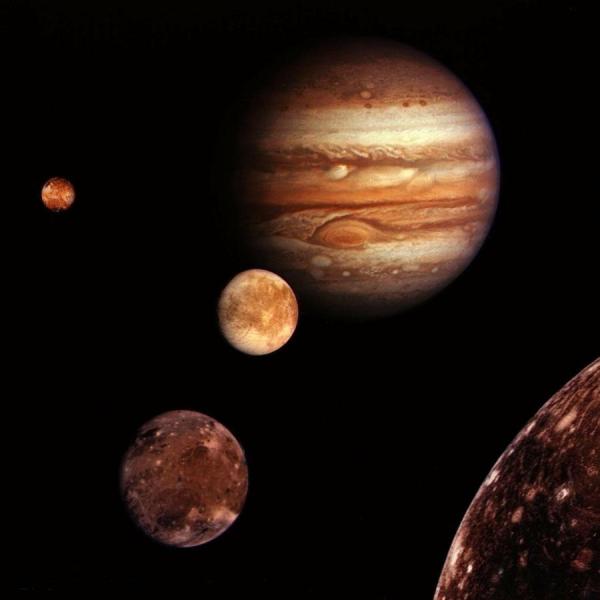
It is not an easy task to determine which is the largest planet in the universe as the technology created by humans has not yet enabled the discovery of a large part of the universe. In fact, 99% of the universe is still believed to have remained undiscovered by mankind.
So, OneHowTo.com reveals which is the largest planet discovered so far.
The largest planet that has been discovered
In November 2012, a group of researchers in Hawaii discovered "Super-Jupiter" which is the largest planet that had been discovered. It is located outside the solar system, 170 light-years away from Earth and is 13 times larger than Jupiter, the largest planet in our solar system.
It was first named "Kappa Andromedae B" but it is colloquially known as "Super-Jupiter". It has an average temperature of 1,400 degrees centigrade. The star that orbits around it is younger than the Sun, being only 30 million years old.
However, experts are not entirely sure if it is a planet, as it could also be a brown dwarf. The classification of celestial bodies like Super-Jupiter often blurs the line between planet and brown dwarf due to their similar characteristics, such as their significant mass.

The second largest planet
In October 2013, another planet was discovered and earned a place as the second largest planet in the universe. This planet has the scientific name MOA-2011-BLG-322. It is 8 times larger than Jupiter and 2,500 times bigger than planet Earth.
This extra-solar planet is about 25,000 light-years away and its mass is equivalent to a third of our Sun. These immense sizes challenge our understanding of planet formation, as they suggest that these bodies may have formed in environments with abundant material.
The discovery of such planets often relies on advanced techniques like gravitational microlensing, which helps scientists detect distant objects by observing the way their gravity affects the light from stars behind them.

The largest planet in the solar system
Within our solar system, the largest planet is: Jupiter. This planet is 1,400 times larger than the Earth. In addition, it is 13 times larger than the rest of the planets that make up our solar system.
Jupiter is basically formed by hydrogen gas and its temperature can drop to 120 degrees below zero. This planet is much faster than ours, as it only takes 9 hours and 50 minutes to orbit the Sun. Its rapid rotation contributes to its oblate shape, causing the planet to bulge at the equator.
Jupiter's atmosphere is known for its dramatic weather patterns, including the Great Red Spot, a massive storm larger than Earth that has been raging for centuries. These dynamic weather systems provide valuable insights into atmospheric processes that may occur on other gas giants.

The largest planet discovered in 2016
In 2016, the NASA discovered the largest planet around a two star system. Its name is Kepler-1647, it cannot be seen by the naked eye as it is 3,700 light-years away. Similarly to Jupiter, Kepler-1647 is a gas giant.
The discovery of Kepler-1647 was significant because it demonstrated the existence of large exoplanets in binary star systems, suggesting that planet formation in such environments might be more common than previously thought. This has important implications for our understanding of the diversity and distribution of planets across the galaxy.

If you want to read similar articles to What Is the Largest Planet Discovered?, we recommend you visit our Hobbies & Science category.